

Codebase Of A Hero
The Call To Rewrite Your Legacy Code

You enter the forest
at the darkest point,
where there is no path.
Where there is a way or path,
it is someone else's path.
You are not on your own path.
If you follow someone else's way,
you are not going to realize
your potential.
~Joseph Campbell, The Hero's Journey: Joseph Campbell on His Life & Work
“I want to be successful. I want to be financially free. I want to find a partner. I want to start a family. I feel like I’m falling behind. I don’t want to settle. I feel stuck.”
These are common sequential refrains I hear from many men and women in tech in their twenties and thirties in the Bay. Many confide that they feel lost, anxious, depressed, lonely, as if serving some predetermined function within a simulation.
I’ve started asking, “Where does this programming that is not your own come from? Do you wish to be free from these patrimonial constraints?”
In the contemplative pause that follows, I often sense their inner inherited code running, ruminating: a familiar executable, carrying the cold, judgmental tone of a disapproving mother or distant father. It’s held in the hunch of their shoulders, the emptiness behind their eyes, their body’s life force blocked by old programming.
Life in SF can oftentimes feel like walking through a high-tech hallucination, a soulless simulacrum filled with optimizing automatons.
What remains unspoken is a chain of spurious correlations: that building a company will grant prestige, that prestige will attract love, and that love will lead to happiness. As if life is linear, fate obeys formulas, faulty functions can optimize expected outcomes, as if karma trades in transactions, as if the soul can be satisfied by external success alone.
I know this legacy source code, for it runs within me as well.

Ancient Init
That is part of the beauty of all literature. You discover that your longings are universal longings, that you’re not lonely and isolated from anyone. You belong. ~F. Scott Fitzgerald
As our institutions of higher education, and by proxy, our society, moves farther away from the humanities and toward the sciences, it becomes increasingly evident why younger generations struggle to connect with their own humanity. We are growing more disconnected from the collective wisdom of our forebears, from their stories, their philosophies, their suffering, from the history of the human experience. When we don’t carry the universal and timeless internal struggles of those who came before us, we arrive at our own dark nights unprepared, feeling lost, alone, and accompanied only by our despair.
I’m grateful that I can turn to stories and mythology to help reconcile my own life. I’ve long understood that my lived experience is both unique and yet shared by countless others who came before me, passed down through paper texts, captured on celluloid, and now, digitally preserved on silicon.
When I look at my own life and the lives of so many others, I see what the author Joseph Campbell must have realized nearly a century ago in his Woodstock shack, contemplating his life’s purpose, that across cultures, there exists a monomythic mythological narrative embedded throughout human history, a kernel of collective codex carrying an eternal truth.
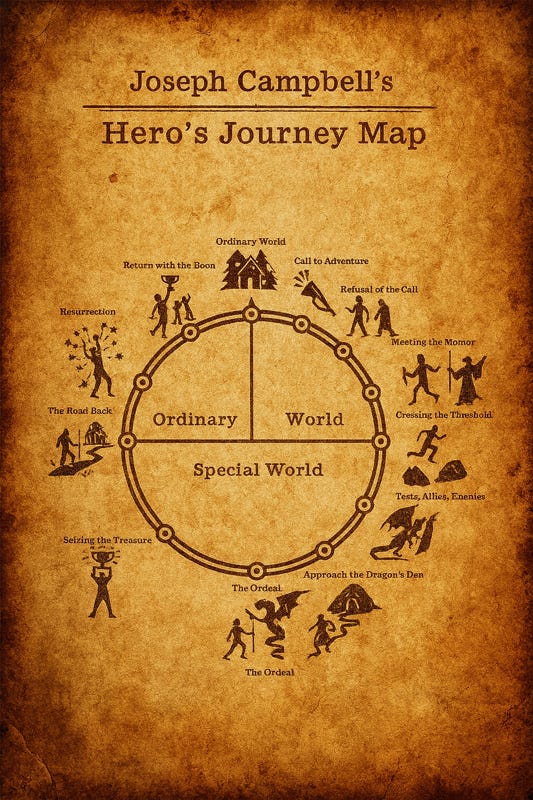
Recently, I’ve begun to see how our pursuit for self-growth generally fits within Campbell’s framework of the archetypal Hero’s Journey. The journey meets us at critical life stages, where we are called to shed an old identity in order to evolve.
At various times in our lives, we all feel the call to adventure. Campbell described this initiation as a disruptive shift that unsettles our lives, often triggered by significant loss, longing or love, that indelibly reshapes how we see ourselves and the world.
Predictably, there is a transitory period when we resist or refuse the call, clinging to comfort, afraid of the unknown, avoiding the likelihood of feeling estranged, abandoned, and alone. Yet the more we resist, the more persistent our internal discomfort becomes. By refusing the summons, we invite the silent suffering and hollow emptiness of a life unlived.
Do we stay stuck, surrendering to our archaic code, retreating back into artificial safety and familiarity, forever shamed by a life unfulfilled, imprisoned within the walls of our own fear? A slave serving an unchosen master? Or do we answer the call, brave the unknown, and courageously venture out to claim our ideal self? Ready to rewrite a new branch? Forking a new hero’s journey?
Self Commit
To dare is to lose one’s footing momentarily. Not to dare is to lose oneself. ~Kierkegaard
Seen through Campbell’s prism, the existential malaise that I have felt mired in for the past year is a natural rite of passage. It’s comforting to know that what I am experiencing is an ancient process, one I have even traversed before, one that every human who has come before me has uniquely undergone time and again. It is not just a call to become a hero, but rather an invitation to become more of myself.
I’m not embarking on a quest to slay dragons, rescue damsels in distress, destroy rings, or defeat despots. I’m not in mortal danger. Yet still, it requires incalculable courage to meet the call to change, for I have choice. I have agency. I can choose to refuse, to cling to what feels safe and no one would be the wiser, except me.
There isn’t some fatal fault within me that will inevitably lead to a complete system failure. Rather, my intuition is receiving escalating warnings, unsettling signals that something is off, not quite right, misaligned. What I am feeling is a feature not a bug.
I answer the call to evolve by updating my codebase and resolving the accumulated technical debt that compromises the integrity of my system. I honor the solemn journey of the hero’s becoming. In doing so, I refuse to revert, restore, reset, or roll back to a previous version.
I want my story to be one of an everlasting mythological metamorphosis: a tireless rewriting and refactoring of my code away from my current self-concept toward an identity that pushes closer to fulfillment and wholeness. An endless evolution, rather than a revolving rebase, that merges the embodied realization that what truly matters to me can only be found in commiseration, communion and connection with other souls.
I commit towards a new unified ideal self rooted in resilience, one who walks alongside in mutuality, leads with service, and prioritizes divine love across all the repositories of my life.
Furthermore, we have not even to risk the adventure alone; for the heroes of all time have gone before us; the labyrinth is thoroughly known; we have only to follow the thread of the hero-path. And where we had thought to find an abomination, we shall find a god; where we had thought to slay another, we shall slay ourselves; where we had thought to travel outward, we shall come to the center of our own existence; and where we had thought to be alone, we shall be with all the world.
~Joseph Campbell, The Hero With a Thousand Faces
Thank you for reading.

All animated images created using The Possible Co. cc: Phil Chacko
You’re commitment to evolution and upgrades is amazing, Mark. I’d love to know how you’ve found a place where the idea of ongoing growth and development doesn’t completely exhaust you…I have times where I can feel the call and know I need to answer (and do) but other times I am utterly exhausted by my own self-awareness. That’s when I have to work extra hard not to roll back! It’s tricky. Great piece xx
I wish I could use this article as an advertisement for my fantasy lit 😅 it's all about how we aspire to be great heroes, but life is not a fantasy story and no single hero or ragtag group are going to save our world. So if you're not saving a fantasy world, what is it that makes you the hero of your own story. That's what the series explores, so naturally, I love this. Keep writing your own story, my friend 💞